
Vincentian-Setonian Legacy
Guided by the teachings of Saints Vincent DePaul, Louise de Marillac and Elizabeth Ann Seton
Our Guiding Founders
From our beginnings to the present day, we, the spiritual daughters of Saint Vincent de Paul, Saint Louise de Marillac, and Saint Elizabeth Ann Seton, follow in their footsteps, living the charity charism.
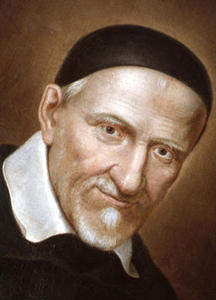
Saint Vincent de Paul
(1580-1660)
In 17th-century France, St. Vincent de Paul sensed a call to manifest the love of God to the people of that time and culture. Stepping boldly into a world that insulated religious women in cloisters, they followed the example of Jesus, ministering in God’s name through ordinary, fully engaging human contact. Our earliest models in the Company of Charity found themselves among God’s people in their homes, on the streets, in hospitals, on the battlefield, and wherever there were urgent needs to be met. Their mission: proclaiming God’s love. Their ministry: serving the needs of all whom they encountered experiencing poverty.

Saint Louise de Marillac
(1591-1660)
Louise was a member of the powerful de Marillac family and was well-educated. Poor health prevented her from joining the strict order of Poor Clares, and in 1613, she married Antoine Le Gras (secretary to Queen Marie de Médicis of France), by whom she had a son, Michel. Widowed in 1625, she had already chosen Vincent de Paul as her spiritual guide, and he encouraged her to undertake charitable works. She trained girls in the spiritual life and taught them to assist in visiting, feeding, and nursing the needy.
Daughters of Charity
In 1633, Vincent de Paul founded the Daughters of Charity with Louise de Marillac as their superior. Because they were neither enclosed nor called nuns, their concept pioneered in bringing women into religious service outside the cloister, devoted to active charitable works, especially in the service of the poor. This was a radical innovation by 17th-century standards.
In nearly every place where St. Vincent de Paul worked, there were congregations of charity among the wealthy women who wished to help the poor. Eventually, peasant girls were gathered to assist the Ladies of Charity and entrusted to the care of St. Louise de Marillac. This group developed into the Daughters of Charity of St. Vincent de Paul. At first, dedicated to nursing the poor in their homes, the sisters began teaching poor children and operating hospitals. They gradually expanded their charitable work. Their services during various wars in many countries earned them the title Angels of the Battlefield.
Saint Elizabeth Ann Seton
(1774-1821)

Elizabeth Ann Bayley was born in New York on the eve of the American Revolution. She was raised in an affluent and well-educated family strongly devoted to the Episcopal Church. However, she often explored the works of great theologians and philosophers from other faith traditions, indicating her complex beliefs. After marrying William Seton and becoming a mother, Elizabeth’s worldview was enriched with new perspectives.
Elizabeth Seton, who once enjoyed wealth and status, fell into poverty and despair. Her relationship with God became a struggle after losing her husband to tuberculosis while on a trip to Italy. However, she eventually underwent a transformation of heart and mind and converted to Catholicism in the beautiful and historic city of Livorno, Italy.
After returning from Europe, Elizabeth Ann Seton joined the Catholic Church on March 14, 1805. Unfortunately, her friends and family disowned her for this decision. She was a single mother of five children with no steady income to support them. Despite the challenges, Elizabeth was able to find support from her Catholic friends and priests. She started working as a teacher initially but soon realized God had a different calling for her.
In 1809, upon the insistence of Rev. Louis William Dubourg, SS, and Bishop John Carroll of Baltimore, Elizabeth established a religious community in Emmitsburg, Maryland. They started by founding St. Joseph’s Academy and Free School, where the education of young, impoverished Catholic girls was subsidized by paid academy students. The early sisters of Mother Seton’s community adopted the Common Rules of the Daughters of Charity and lived a Vincentian life by serving the poor. The community’s missions extended beyond education to include orphanages, infirmaries, and other social service institutions.
Elizabeth died in 1821 at the age of 46 after enduring numerous hardships and heartaches throughout her short life. Nevertheless, the success of the small community she built filled her with immense joy. Her sisters had great affection for “Mother Seton,” and her legacy continued to thrive. Generations of Americans, young and old, Catholic and non-Catholic, poor and rich, have benefited from Elizabeth’s vision for the world. Mother Seton’s spiritual daughters, infused with the Setonian charism, have continued and broadened the missions of those first sisters in Emmitsburg. The Vincentian-Setonian charism not only infuses and strengthens the congregation, it also becomes manifest in the various missions of the sisters.
The significance of Elizabeth Ann Seton’s legacy was declared in her sainthood when the triumphant day arrived on Sunday, September 14, 1975. All over the United States and around the world, people rejoiced when Pope Paul VI proclaimed: “Elizabeth Ann Seton is a saint.”
Saint Elizabeth Ann Seton is the first American-born saint and the foundress of the first religious community of women in the United States. She was a pioneer in the field of free education and advocated for the rights of the poor and needy, racial equality, and religious freedom. The Federation of Sisters of Charity of North America are proud to be known as her daughters.
Learn more by visiting The National Shrine of Saint Elizabeth Ann Seton.