
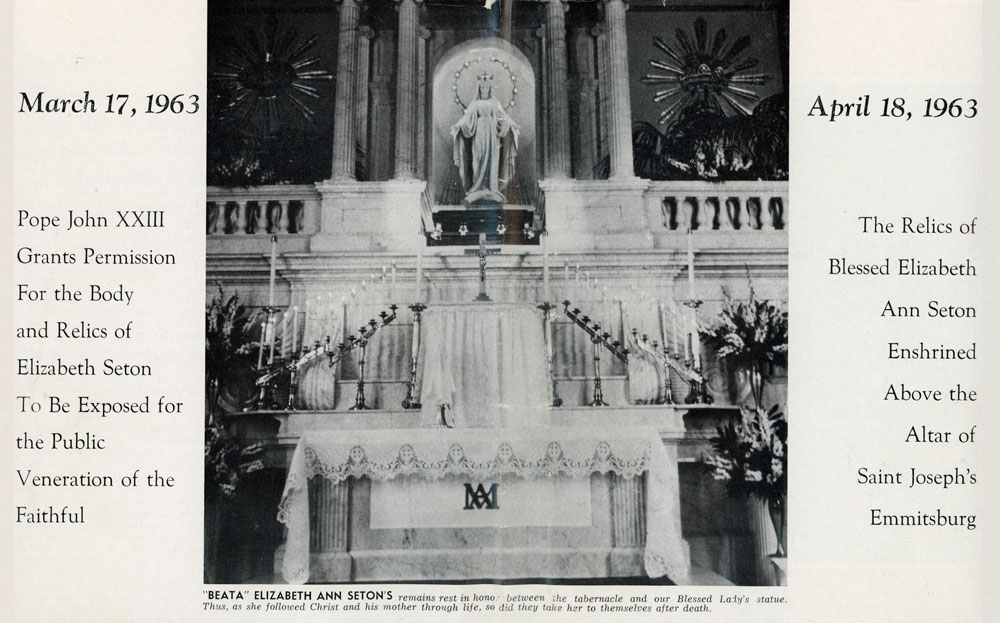
“BEAT A” ELIZABETH ANN SETON’S remains rest in honor: between the tabernacle and our Blessed Lady’s statue. Thus, as she followed Christ and his mother throughout life, so did they take her to themselves after death.
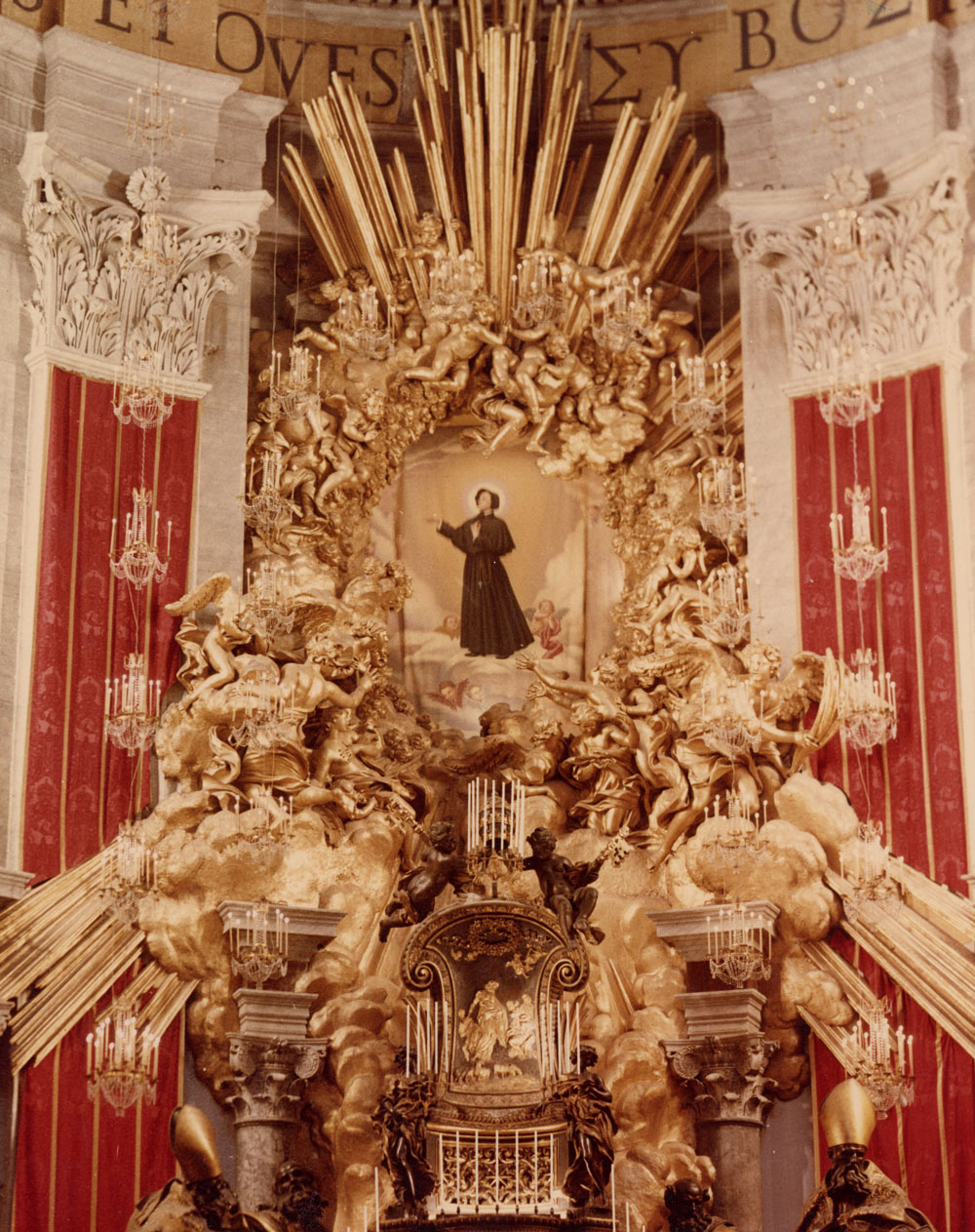
Detailed view of the painting of Mother Seton in Glory unveiled after the decree had been read. Simultaneously, all the candlelabram flooded the picture with brilliant light. Immediately below the painting is a carved chair of St.Peter. The chair is upheld by huge bronze sculptures of four doctors of the Church: Ambrose, Athanasius, Augustine, and Cyril.
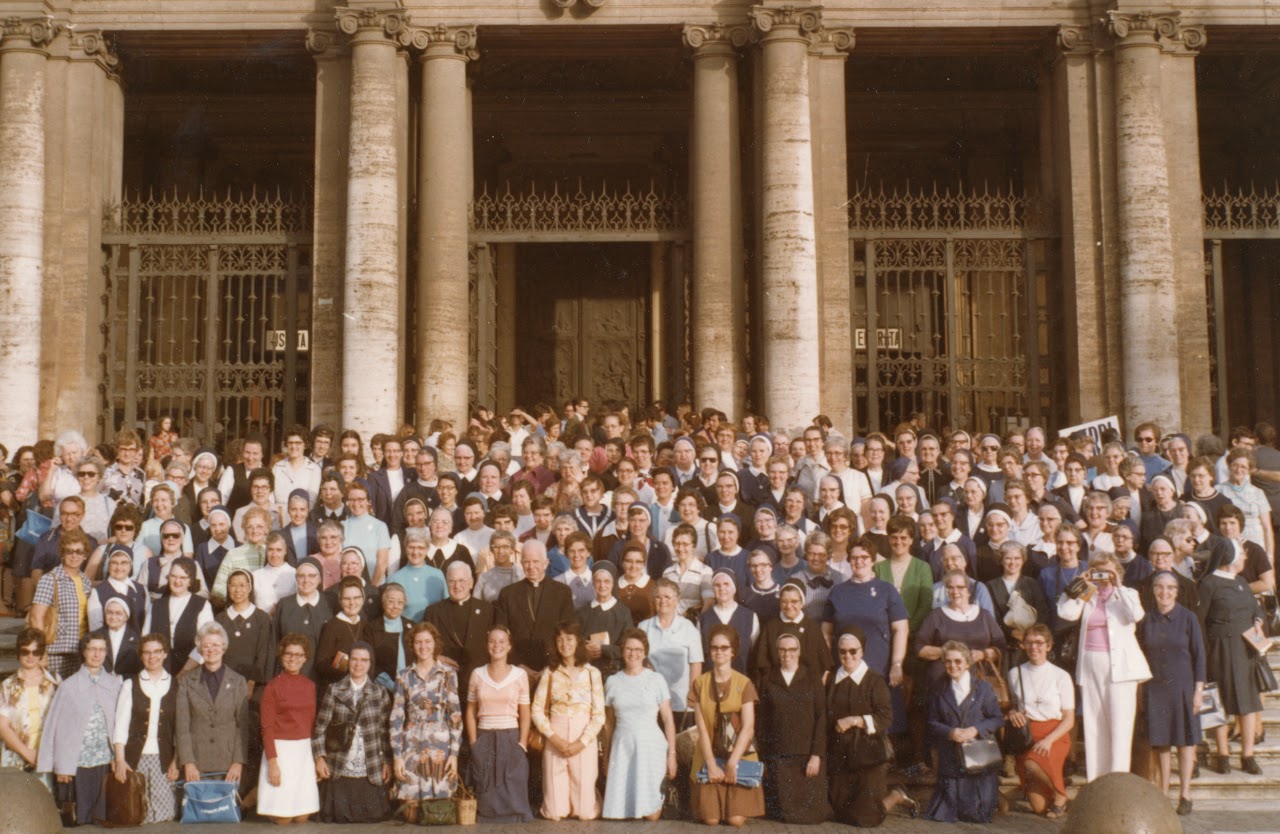
September 14, 1975 was the culmination of a decades-long effort to canonize Elizabeth Ann Bayley Seton, the first American-born saint. Millions of faithfully devoted Catholics turned their eyes and ears to Rome as Pope Paul VI declared, “Elizabeth Ann Seton is a Saint!” However, Elizabeth’s path to sainthood was nearly as bumpy as her own life.
The cause for canonization truly began in 1882 when Archbishop James Cardinal Gibbons of Baltimore suggested to the Daughters of Charity in Emmitsburg that he would pursue sainthood for Elizabeth. To canonize an individual, though, requires a significant amount of research and evidence to prove his/her holiness. Church leaders in Emmitsburg and Baltimore began a formal study of Elizabeth’s life in 1907 and the Postulator of the Cause in Rome was given an initial report in the 1910s.
Elizabeth Seton’s cause for canonization was not formally introduced, though, until February 28, 1940. Pope Pius XII signed the decree as the first official document in English from the Holy See. The Mother Seton Guild was developed in order to promote the life and legacy of Elizabeth Seton and engage devotees in her cause for canonization. It would take the power of prayer, and a few miracles, to realize sainthood.
The First Conference of Mother Seton’s Daughters was held in Emmitsburg, Maryland in 1947. This special day saw each of the congregations descended from Mother Seton’s roots gather together for the first time in order to advance the canonization of their foundress. The Daughters and Sisters of Charity began to appreciate their founding Mother with a new zeal and felt the need to share her legacy. As more members of the public came to know Elizabeth, her story of faith and resiliency gained strength and power.
On December 18, 1959, Elizabeth Seton was declared a “Venerable Servant of God” by Pope John XXIII. This milestone meant the Holy See recognized that Elizabeth Seton lived a life of “heroic virtue.” It was at this time that Mother Seton found a home on the Seton Hill College campus for the first time – as her statue was installed outside Havey Hall. “Mother Seton” became a household name. Although Elizabeth had won the hearts of the people, the paperwork in Rome was still a necessary part of the journey.
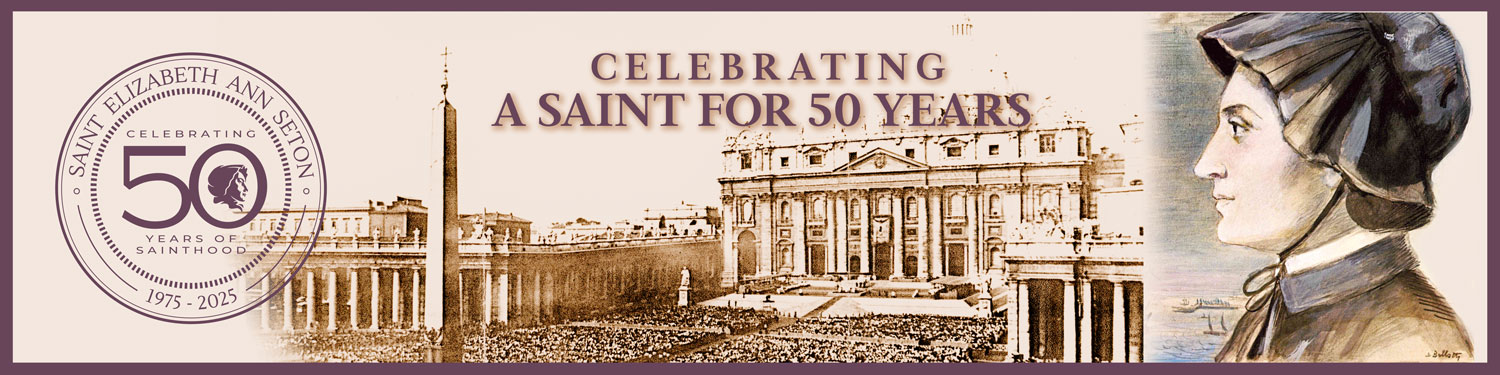
Two verified and approved miracles are a required part of the canonization process. It is believed that Mother Seton interceded on behalf of a Daughter of Charity with pancreatic cancer and a child with leukemia. These miracles were approved in 1961. She became “Blessed Elizabeth Seton” at the Beatification ceremony in Rome on March 17, 1963, the final step before a declaration of sainthood.
Between the 1940s and 1960s, individuals like Monsignor Joseph B. Code, Rev. Charles I. White, Joseph I. Dirvin, and our own Sister Fides Glass brought renewed attention and interpretation to the life and legacy of Elizabeth Seton through biographical and spiritual studies. These publications brought Elizabeth to life in a way that was accessible to the masses.
It was all the more meaningful when, in 1975, Elizabeth Seton was canonized during the International Year of Women and the Bicentennial of the United States. Fireworks erupted on the Seton Hill College campus. Sisters of Charity from Greensburg, Pittsburgh, Altoona, Tucson, and Korea rejoiced. President Gerald R. Ford declared Sunday, September 14 as National Elizabeth Seton Day while the country, and the world, celebrated America’s first saint with great jubilation.